




The best app of 2020 would struggle to compete in the future.. Great design and fast performance still matter, but they are no longer enough on their own. Apps are evolving. Intelligent interfaces are digital products that understand user intent, anticipate needs and act, not just display information and wait for input. They can live inside an existing app. In this article, we explore what this evolution means and what companies need to do to stay ahead.
You’ll learn:
- How Intelligent Interfaces are changing the way users discover and interact with digital products
- The five emerging models of Intelligent Interfaces
- Why competitive advantage is moving from UI to intelligence
- How companies can prepare their products for what comes next
How we got here
In October 2007, Steve Jobs introduced the iPhone and, with it, the idea that an application — a discrete, bounded piece of software purpose-built for a single task — was the fundamental unit of the digital experience. You needed to check email: you opened an email app. Navigate: a maps app. Pay: a payments app. The logic was intuitive, the metaphor was physical — a screen full of icons, each a door to a separate room.
That architecture dominated digital product design for nearly two decades. Companies built competitive advantage by building better apps. More features. Better UX. Faster load times. Cleaner flows. The leaderboard was the App Store rating and the chart position. The scorecard was daily active users, session length, and app store ranking.
That era is evolving faster than most enterprise product teams realise. Yet many are still optimising for a competition that has already moved on.
Far from a distant-future prediction, this reflects what is already happening in the data, in the behaviour of hundreds of millions of users, and in the strategic decisions being made today by the companies shaping the next generation of digital products.
Why Intelligent Interfaces Are Changing Mobile App Experiences
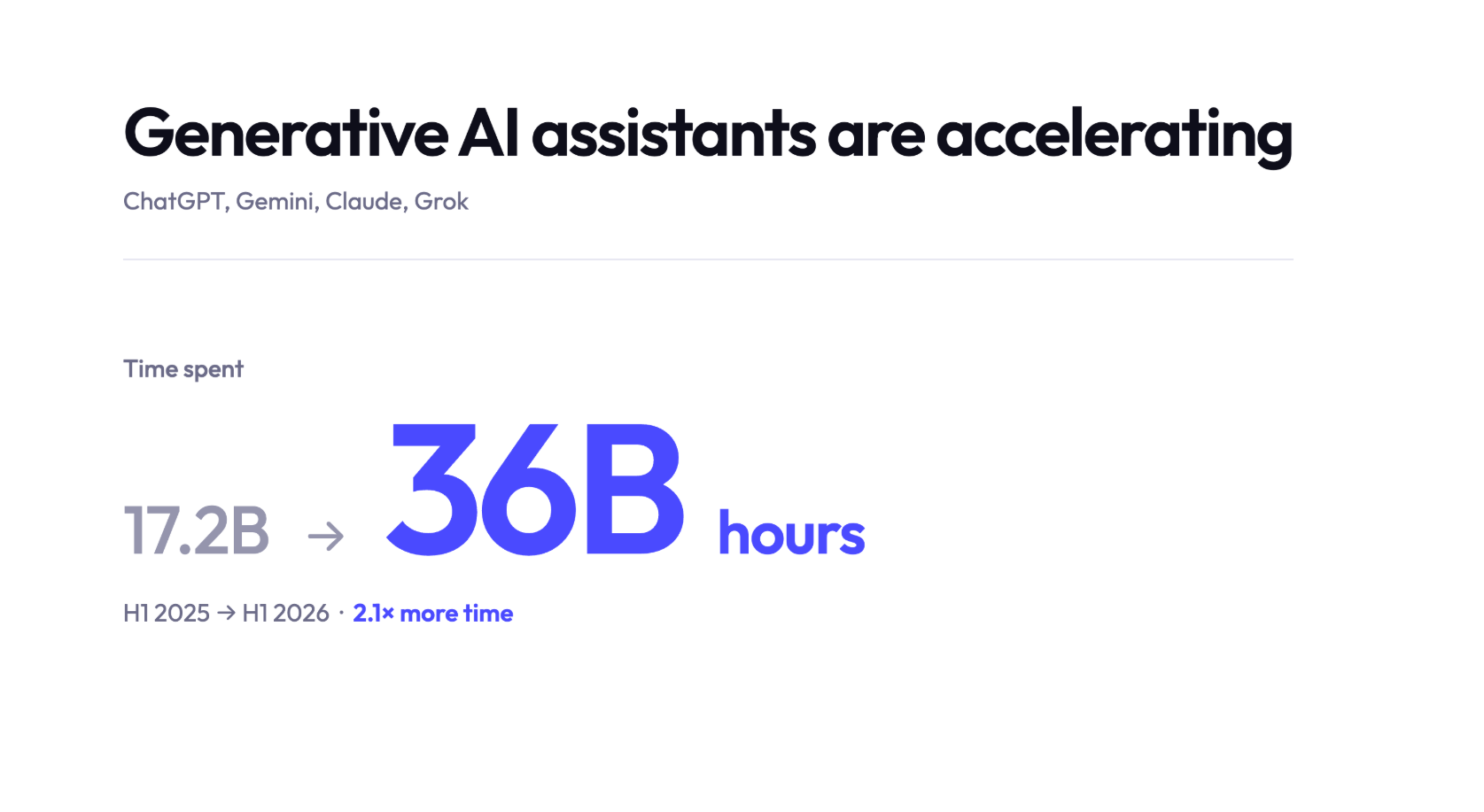
According to Sensor Tower’s State of AI 2026 report, time spent on generative AI apps is expected to more than double year over year — from 17.2 billion hours in H1 2025 to 36 billion hours in H1 2026. Users are also expected to download nearly 2.3 billion AI apps during the first half of 2026 alone, generating more than $4.2 billion in consumer spending.
At the same time, growth in the broader app market is beginning to slow. Download growth has decelerated across mature markets, while Asia recorded its first quarterly decline in app downloads in Q1 2026.
The evolution is also visible in how people interact with software. AI assistants are becoming a new layer between users and digital products. ChatGPT crossed 1 billion monthly active users in June 2026 , and its market share has already fallen below 50% as users distribute across Gemini, Claude, Grok and others. AI interaction is not consolidating around one product. It is becoming infrastructure.
The same pattern is emerging in the enterprise. McKinsey’s 2026 State of AI survey reports that 88% of organisations now regularly use AI in at least one business function, while 72% use generative AI — up from 33% in 2023. Yet only 39% report any measurable EBIT impact. The majority of organisations have adopted AI. Far fewer have fundamentally rethought their products and operating models around it.
Looking ahead, Gartner predicts that 40% of enterprise applications will be integrated with task-specific AI agents by the end of 2026, up from less than 5% in 2025. By 2028, Gartner estimates that a third of user experiences will shift from native applications to agentic front ends.
What this looks like in practice
Real companies are already moving beyond traditional app experiences and using AI to make interactions more natural, contextual and intelligent.
In banking, BNP Paribas uses its AI-powered assistant NOA to help customers find information and navigate banking services without moving through multiple screens.
In healthcare, Doctolib is developing AI capabilities to support healthcare professionals and patients across the care journey, from administrative tasks to health-related guidance.
If this evolution is already happening in your industry, the question is no longer whether AI will affect your product. It is how your product should evolve.
The gap between deployment and value starts with architecture. Let’s talk about yours.
A brief history of interface evolution
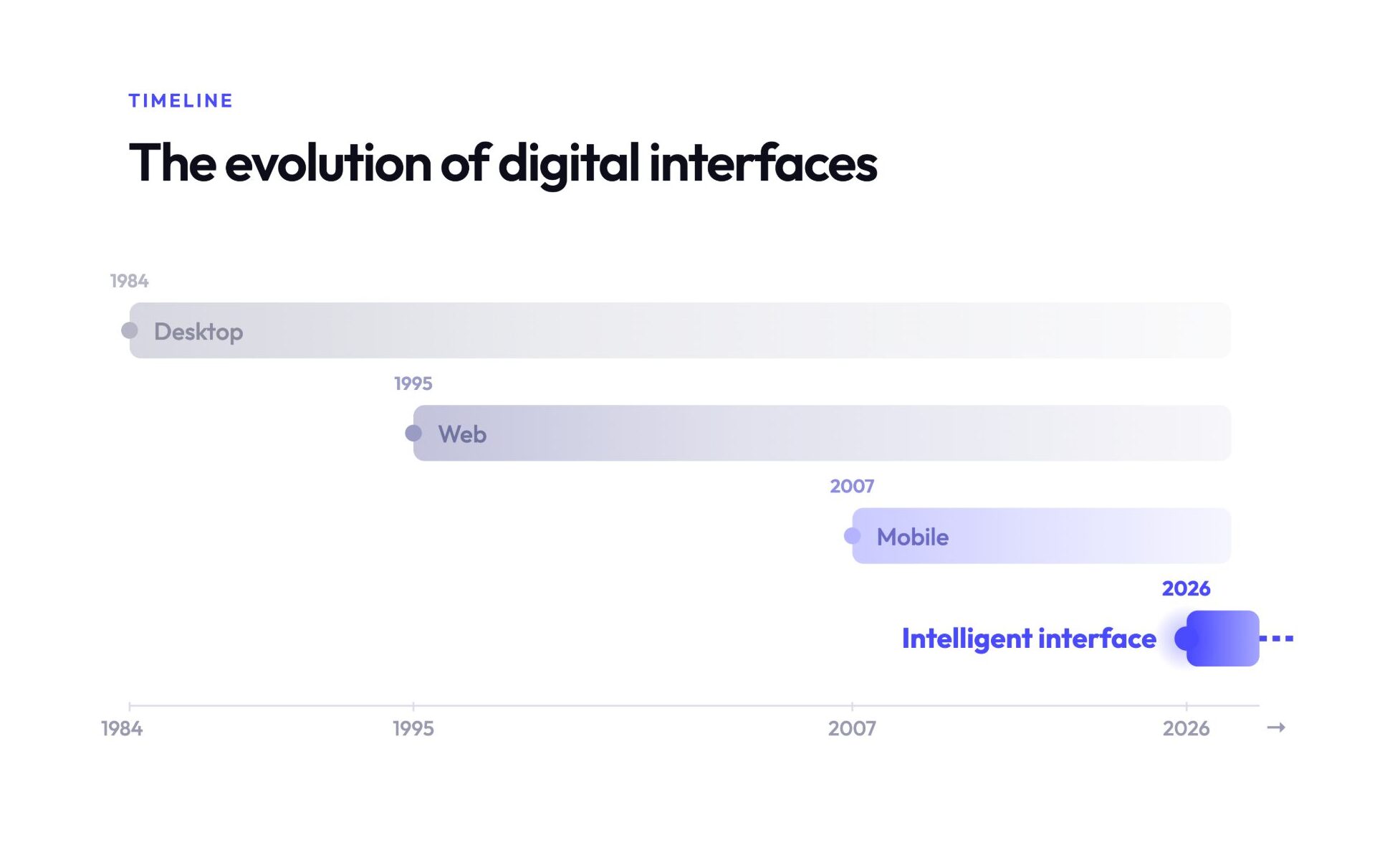
To understand where we are going, it is worth understanding where we have been — because every major interface shift follows the same pattern, and we are in the middle of one now.
The Desktop Era (from 1984) established the fundamental metaphor of the digital experience: the GUI. Files, folders, menus, windows. Competitive advantage belonged to companies that built the most powerful and usable desktop software.
The Web Era (from 1995) redistributed access. Software could be delivered to anyone with a browser. Competitive advantage shifted to companies that controlled distribution and attention on the open web.
The Mobile Era (from 2007) introduced the app as the atomic unit of experience. Competitive advantage belonged to companies that owned prime real estate on the home screen.
The Intelligent Interface Era ( from 2026) is not a replacement for what came before. It is the next layer. AI capabilities are being embedded inside existing applications, making them conversational, proactive and capable of acting on behalf of the user. Competitive advantage will belong to companies that move from delivering information to understanding intent — regardless of whether that happens inside a mobile app, a web platform or an AI assistant.
The architecture of what comes next
Five interaction models are shaping the next generation of digital products.
- Conversational interfaces: the user describes what they need in natural language; the interface understands intent and responds with the relevant information, action, or guidance.
- Proactive and ambient interfaces: surface relevant information and suggested actions based on context, rather than waiting for the user to articulate a need. The banking notification that flags an unusual transaction. The logistics tool that flags a delivery risk before the window closes.
- Agentic interfaces: the most significant structural shift. An agent can not only understand and respond, but take action: execute a transaction, book an appointment, submit a form. The user’s role shifts from navigator to approver.
- Embedded intelligence: Intelligent capabilities that live inside existing applications and transforms their interaction model without requiring users to switch to a new interface.
- Cross-platform intelligence: AI systems that operate across devices, applications, and contexts simultaneously. Apple Intelligence, deepened with iOS 27, acts as a unified intelligence layer across a user’s email, calendar, messages, and apps.
What this means for product strategy
The question is evolving: not just “How do we build a better app?” but “How do we make it intelligent enough to meet users wherever they are?”.
As a result, the competitive moat shifts from UI to intelligence. In the app era, competitive advantage was built on a great user experience, one that competitors could eventually imitate. In the interface era, competitive advantage is built on the quality of the intelligence layer: how well the system understands user intent, how accurately it predicts needs. This advantage compounds over time in a way that UI improvements do not.
However, the risk is not acting. Companies that treat AI as a feature to bolt on later will find the gap expensive to close.
Yet many are still optimising for yesterday’s definition of a great product. Meanwhile, competitors are building intelligence layers. The gap will not be obvious immediately. By the time the displacement is visible in headline metrics, the architectural disadvantage is significant and expensive to reverse.
The next 36 months in Europe
EUDI Wallet deployment (December 2026).
The EUDI Wallet is the EU’s digital identity wallet. All 27 EU member states are required to provide at least one fully compliant EUDI Wallet by December 2026, with regulated sectors required to accept EUDI Wallets for strong authentication by mid-2027. France Identité is already live. It will allow people to store and verify credentials such as identity documents, driving licences and other official information digitally. As EU countries roll out these wallets, users will increasingly expect to identify themselves and access services without repeatedly creating accounts, entering passwords or completing lengthy verification processes.
For product teams, this means authentication will become less of a differentiator. The opportunity will shift towards what happens after the user is identified — how intelligently the product understands and serves their needs.
Apple Intelligence maturity. With iOS 27, Apple is increasingly enabling Apple Intelligence to interact with apps through technologies such as App Intents. This means users may be able to ask an AI assistant to perform actions across apps instead of opening each app manually.
For example, a user could ask an assistant to find an available appointment, check their insurance details or make a payment.
Apps that are not designed to work with these system-level AI capabilities risk becoming less visible in the new user journey. For organisations in regulated sectors such as banking, insurance and healthcare, AI integration is becoming a core product capability rather than an optional feature.
Enterprise AI assistant proliferation
Tools such as Microsoft Copilot, Google Workspace AI and enterprise versions of Claude are changing how employees interact with business software.
Instead of navigating through multiple systems, employees will increasingly ask AI assistants to find information, create documents, analyse data or complete tasks.
This means software companies will need to make their products accessible to AI assistants through integrations, APIs and technologies such as MCP. The products that are easiest for AI systems to understand and use will have a significant advantage.
EU AI Act enforcement
The EU AI Act introduces requirements around transparency, explainability and human oversight, particularly for high-risk AI systems.
This means compliance can no longer be treated as something added at the end of development. Companies will need to design AI systems that can explain their decisions, provide appropriate human control and make their behaviour understandable to users.
The companies that build these capabilities into their products from the beginning will be better positioned than those forced to retrofit them later.
How to Prepare Your Product for Intelligent Interfaces
Not every organisation needs to rebuild its products from scratch. Some products need modernisation. Others are ready for new AI capabilities. In some cases, the biggest opportunity is making existing products work with the next generation of interfaces.
The important step is understanding where your product is today and choosing the right direction. At Tapptic, we typically see five approaches:
Understand where you are
Before making technology decisions, assess your current product, architecture and business goals to identify where AI can create real value.
Modernise existing products
Improve the technology foundation, user experience and architecture so the product is easier to evolve over the coming years.
Add intelligence to existing apps
Introduce features such as natural language search, recommendations, assistants or automation without rebuilding the entire application.
Build new AI-native products
When the business case requires a different type of experience, design products around conversation, automation and intelligent workflows from day one.
Prepare for the next interface
As more interactions happen through assistants and connected platforms, products need to work beyond their own app through APIs, integrations and technologies such as MCP.
There is no single path. The right approach depends on the product, the business and where you want to be in the next two to five years.
The Future
The companies that survived previous technology transitions were the ones that asked the right question. Instead of focusing on the format, they restructured around the function. The same evolution is happening now.
“How do we build a better app?” is becoming an incomplete question.
The better question is:
“What could our product do if it could understand, anticipate and act?”
The next generation of digital products will not simply be more intelligent versions of today’s apps. They will be products designed around intelligence from the start. Able to understand users, anticipate needs and take action.
The companies that understand this shift now will be the ones building the products that define the next decade.