Veolia runs complex industrial sites in Belgium. This project focused on one thing: making boiler maintenance simpler and more modern across several Veolia sites.
Above all, the plan was to replace a bulky, 300-page paper manual with clear Augmented Reality (AR) steps. As a result, the new mobile app would cut human error and help field teams work much faster.
01
Overview
Our Challenge was to transform static manuals to dynamic operations
Veolia’s field teams used heavy paper playbooks (draaiboek) for complex boiler maintenance. As a result, during urgent jobs, they had to keep checking paper steps against the real machines.
In particular, they faced three challenges:
Lost time: because staff checked everything by hand, key tasks took longer.
Risk: complex, multi-step tasks had to be done with great care, often under pressure.
Rigid workflows: in addition, fixed paper workflows could not easily handle new situations.
02
The Solution
Spatial Guidance for Field Technicians
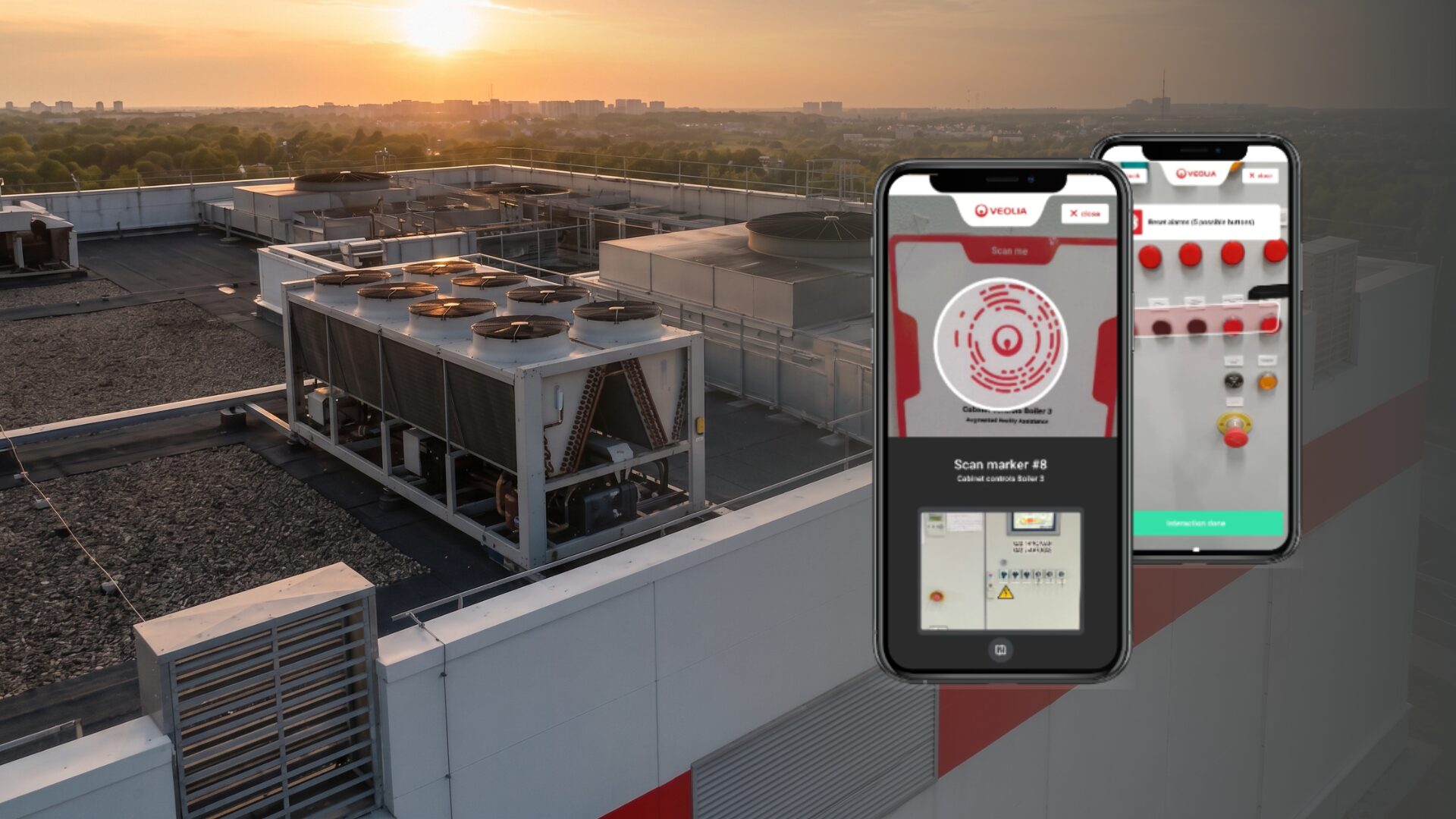
Therefore, Tapptic built an Augmented Reality mobile app in Unity, tuned for ARCore-compatible Android devices. As a result, the steps appear right in the user’s field of view.
Spatial guides: QR markers on the boilers act as anchors. The app therefore places digital steps right over the real parts.
Clear interface: visual callouts, highlights and frames guide the eye. In other words, they show where to look and what to do next.
Smart branching: the flow adapts to the situation in real time. So staff follow the right path for each case, based on the way the site already works.
03
The Outcome
In short, the solution turned complex boiler maintenance into a simple, guided workflow:
40% less time per job: with simpler workflows, field work became much faster as a result.
Less risk of human error: because the guidance is spatial and the steps adapt, complex tasks are easier and safer under pressure.
All key steps in one app: finally, several manuals now live in a single, easy mobile app.