




AI Agent vs Chatbot Guide
AI agent vs chatbot is not a question of old versus new. A chatbot answers. An AI agent acts: it plans the steps, uses your systems and finishes a task. Both are useful in 2026, and both fail when they are put on the wrong job.
The cost of a wrong call shows up late. Choose a chatbot for work that needs action, and customers get polite answers that still end in a phone call. Choose an agent for work that only needs answers, and you pay for integrations, guardrails and compute you didn’t need. Gartner expects over 40% of agentic AI projects to be cancelled by the end of 2027, mostly for rising costs, unclear value or weak risk controls.
This AI agent vs chatbot guide is for CDOs, CTOs, product owners and heads of customer service who have to make the call and defend it. It compares the two on how they work, use cases, cost, risk, EU AI Act duties and data readiness, then gives you a decision tree. It’s written by Tapptic, part of the ENEON group, where we build both.
In short: choose a chatbot when the job ends with an answer: questions about products, policies, orders or internal procedures. Choose an AI agent when the job ends with something done in another system, such as a claim filed, a slot booked or an invoice matched, and the volume is high enough to pay for the integration. If the steps never change, you may need neither: a plain automated workflow is cheaper and more predictable.
In this guide
- AI agent vs chatbot at a glance
- How chatbots and AI agents work under the hood
- From chatbot to agent: the four levels of automation
- Use cases: where a chatbot is enough and where an agent pays off
- AI agent vs chatbot cost: build, run and maintain
- Risk, governance and the EU AI Act
- Is your data ready for an agent?
- Chatbot, AI agent or neither: a decision tree
- Already have a chatbot? How to upgrade it step by step
- How we choose between a chatbot and an AI agent at Tapptic
- FAQ: AI agent vs chatbot
AI agent vs chatbot at a glance
The table below sums up the AI agent vs chatbot comparison as of November 2026. Each row is explained further down.
| AI chatbot | AI agent | |
|---|---|---|
| What it delivers | An answer, a summary or a draft | A finished task: something changed in another system |
| How it works | Reads the question, finds the relevant content, replies | Breaks a goal into steps, calls tools and APIs, checks the result, repeats until done |
| Typical example | “What does my policy cover for a stolen scooter?” | “Report my stolen scooter”: opens the claim, attaches the photos, books the call-back |
| Access to your systems | Read-only: knowledge base, FAQ, sometimes order status | Read and write: CRM, ERP, ticketing, payments, calendars, via APIs or MCP |
| Who is in control | The user acts on the answer | The agent acts; a human approves the risky steps |
| Build effort | Weeks: content, retrieval, tone, testing | Months for the first workflow: integrations, permissions, guardrails, evaluation |
| Running cost per interaction | Low | Several times higher: an agent makes many model calls per task |
| Main risk | A wrong answer the company is liable for | A wrong action: a refund, an order or a record change that should not have happened |
| EU AI Act (Article 50) | Must tell users they are talking to an AI | Same duty, plus high-risk rules if it decides on credit, insurance or hiring |
| Best fit | High-volume questions with stable answers | Repetitive multi-step work across systems, with clear rules for success |
Sources: McKinsey, The state of AI in 2026, Anthropic engineering, EU AI Act Article 50.
How chatbots and AI agents work under the hood
The biggest difference between a chatbot and an AI agent is where the work ends. Most other trade-offs in this guide follow from it.
A chatbot answers. Today’s AI chatbots run on a large language model. They read the question, retrieve the relevant passages from your content (a technique called retrieval-augmented generation, or RAG) and write an answer. Older bots follow scripted decision trees instead. Either way, the conversation ends with information, and the user still does the task.
An AI agent acts. An agent uses the same kind of model, but in a loop. It turns a goal into steps, calls tools such as your CRM, booking engine or payment system, reads the result and decides what to do next. It stops when the goal is met or when it needs a human. Anthropic, which builds the Claude models, describes agents simply as models using tools in a loop.
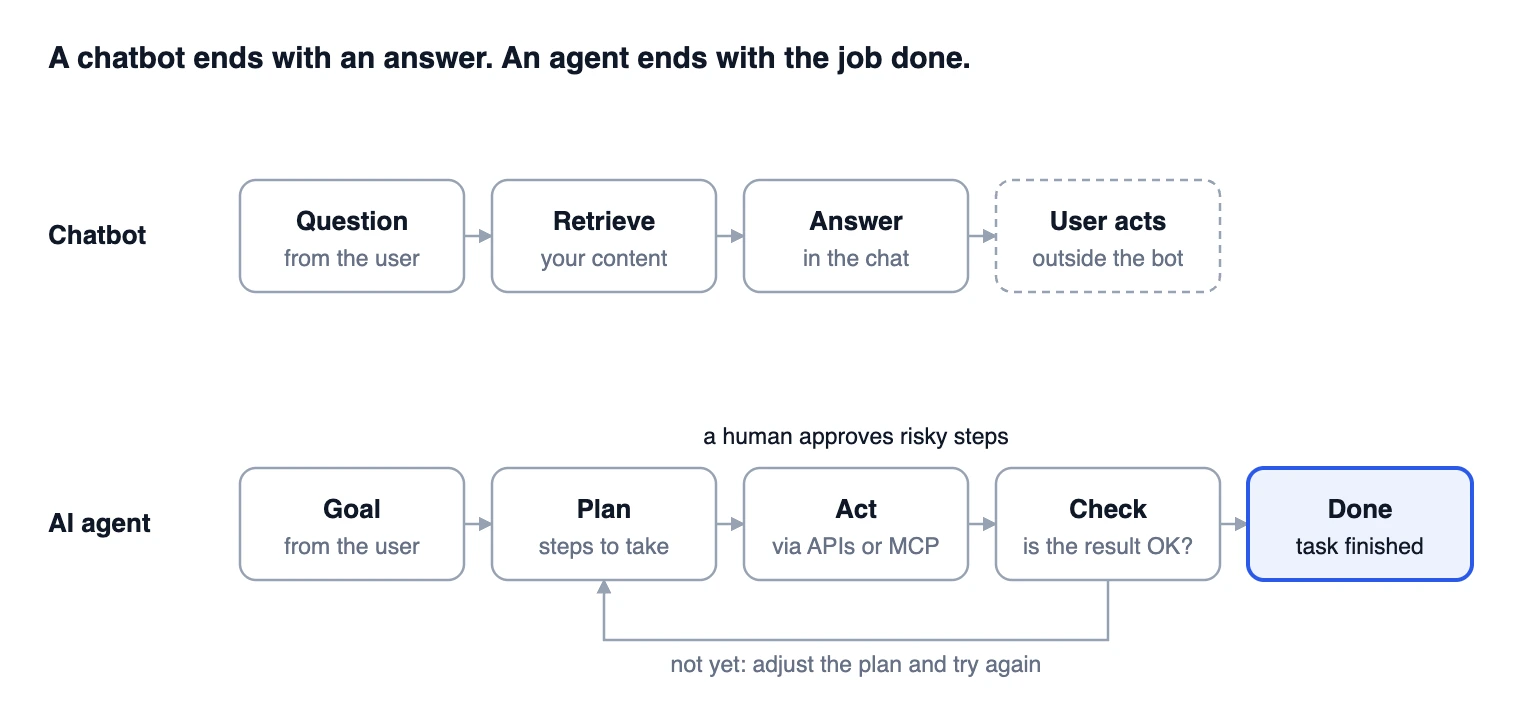
What this means for you: a chatbot is a content project with a conversational front end. An agent is an integration project with a model inside, and it needs the same engineering discipline as any system that can change your data.
From chatbot to agent: the four levels of automation
“Chatbot” and “agent” are two points on a scale, not two products. Placing your project on it is the fastest way to cut through vendor claims. Gartner calls the problem agent washing: rebranding chatbots, assistants and automation as agents. It estimated that only about 130 of the thousands of vendors claiming agentic AI offered the real thing.
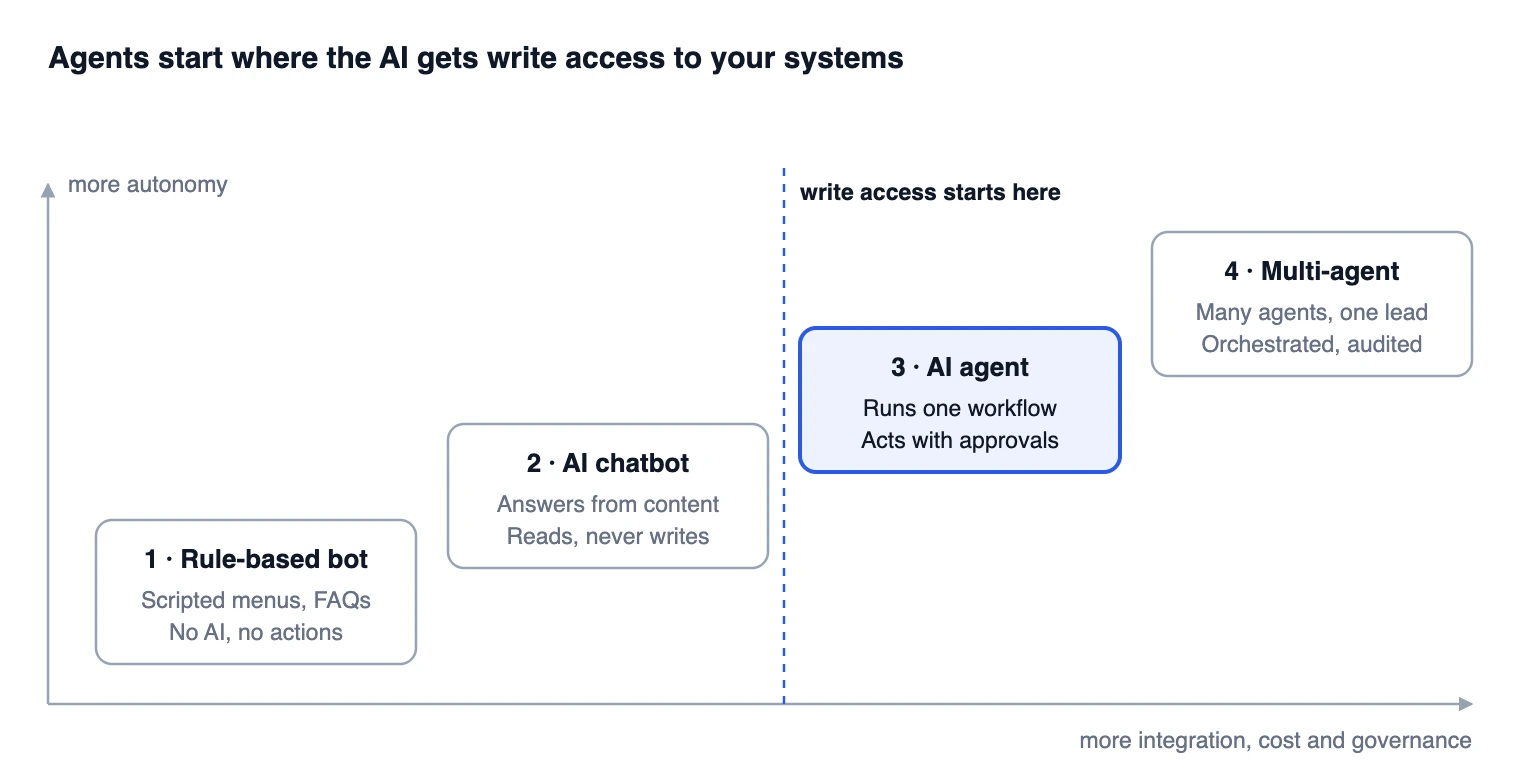
- Level 1, rule-based bot. Buttons and scripted answers. Predictable and cheap, but it breaks as soon as a question falls outside the script.
- Level 2, AI chatbot. A language model answers in natural language from your approved content. It reads; it never writes.
- Level 3, AI agent. The assistant completes one defined workflow across a few systems, with a human approving the risky steps.
- Level 4, multi-agent system. Several specialised agents, coordinated by a lead agent, with routing, memory, guardrails and human checkpoints. This is where most of the engineering effort sits.
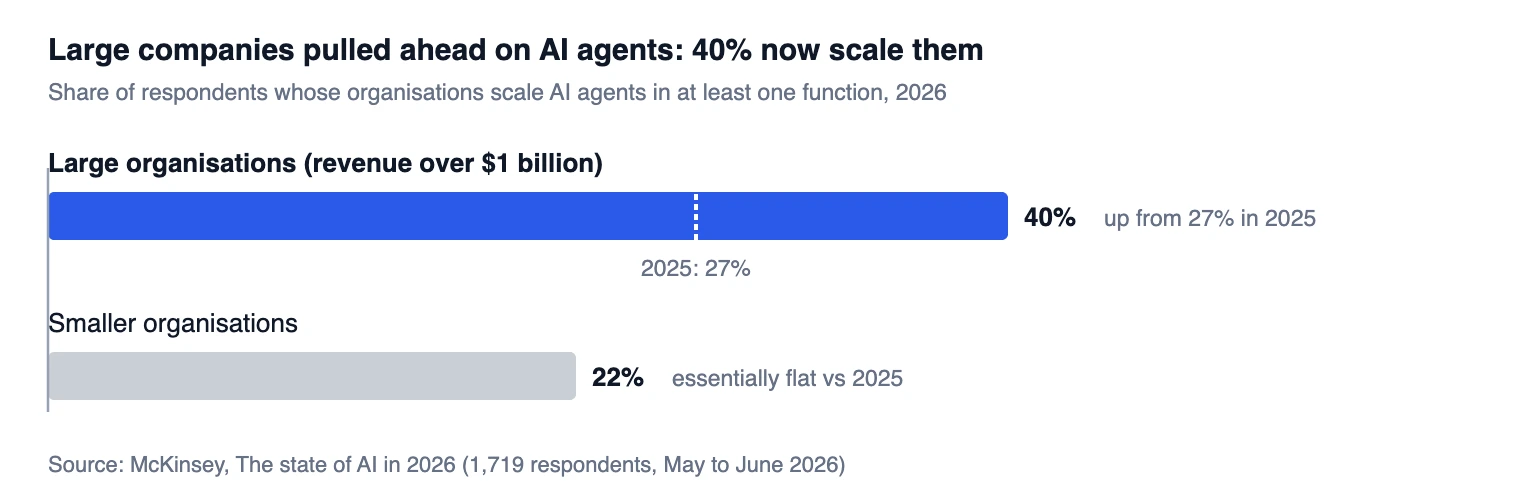
Where companies stand in 2026. Chatbots are still far more common than agents. McKinsey found that 47% of respondents say their organisations scale chatbots across the enterprise, against about two in ten for AI agents. Large companies are moving fastest.
Use cases: where a chatbot is enough and where an agent pays off
Most departments need both, for different jobs. The test is the same everywhere: does the conversation end with an answer, or with work done in a system?
| Area | A chatbot is enough when… | An AI agent pays off when… |
|---|---|---|
| Customer service | Customers ask about delivery times, returns policy or opening hours | Customers want the return processed, the address changed or the refund issued, and the rules are clear |
| Insurance | Policyholders ask what their cover includes | The assistant quotes, compares, subscribes and opens claims, with a human approving exceptions |
| Retail and e-commerce | Shoppers ask about sizes, stock or care instructions | The assistant builds a basket from a recipe or a brief and hands it to checkout |
| HR and employee services | Staff ask about leave rules, benefits or expense policy | The agent books the leave, files the expense and updates the HR system |
| IT support | Users need the steps to reset a password or set up VPN | The agent resets access, opens the ticket with the right category and closes it when the fix is confirmed |
| Finance and back office | Teams look up a procedure or a supplier’s terms | The agent matches invoices to orders, flags gaps and prepares payments for approval |
| Sales | Reps search past proposals and references | The agent prepares a first offer from CRM history, past projects and pricing rules |
Two patterns stand out. Agents earn their cost where the same multi-step job repeats thousands of times with clear rules for success. And the closer the action gets to money, contracts or regulated decisions, the more a human approval step belongs in the flow.
Agent use is most often scaled in IT, knowledge management and software engineering, where the work is digital, repetitive and easy to check (McKinsey, 2026).
AI agent vs chatbot cost: build, run and maintain
An AI agent costs more than a chatbot at every stage. The question is whether the work it finishes is worth more than the gap. Compare the two on three lines of the budget, not on the first release.
Build. A chatbot is mostly a content and conversation project: clean source content, retrieval, tone, testing. An agent adds integrations with each system it touches, user permissions, approval steps, error handling and a test set of real cases. The first agent workflow usually takes several times the effort of a chatbot on the same topic.
Run. Every model call is paid in tokens, and agents make many calls per task: they plan, call tools, read results and check their work.
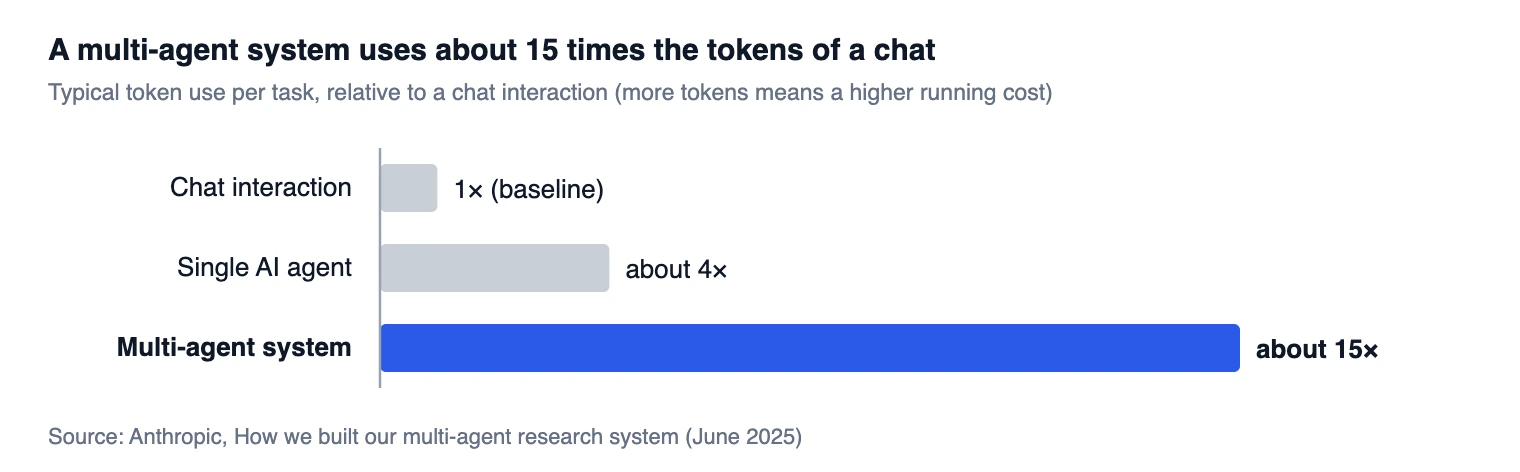
That multiplier is fine when each finished task replaces minutes of skilled work. It’s expensive for questions a chatbot answers in one call. Running costs are already a real constraint: in McKinsey’s 2026 survey, one in five respondents said operating costs, including tokens, limit their AI use.
Maintain. Models change several times a year, your policies and systems change too, and both need retesting. Budget for monitoring, prompt and test maintenance, and content updates, not only for the launch.
How to measure it. Judge an agent against the fully loaded cost of the work it replaces. Track these KPIs from the pilot onwards:
- Cost per resolved request, compared with the same request handled by a person
- Resolution rate: the share of requests finished without a hand-off
- Time to resolution
- Error and escalation rate, including actions reversed after the fact
- Customer or employee satisfaction on the handled requests
- Share of actions that still need human approval, tracked over time
Risk, governance and the EU AI Act
A chatbot can say something wrong. An agent can do something wrong. That difference sets how much control each one needs.
You own what your chatbot says. In February 2024, a Canadian tribunal held Air Canada liable after its website chatbot gave a customer wrong information about bereavement fares. The airline argued the chatbot was responsible for its own words; the tribunal rejected that. The lesson applies to any chatbot: answers must come from approved, current content, and the bot must say when it doesn’t know.
You own what your agent does, too. An agent with write access can issue a refund, change a contract or delete a record. The controls that matter:
- Least privilege. Give each agent only the actions its job needs, with the user’s own permissions, never an admin account.
- Human approval for irreversible steps. Payments, cancellations and anything regulated wait for a person to confirm.
- Audit logs. Every tool call, input and result is recorded, so you can explain what happened and why.
- Evaluation before and after launch. A test set of real cases, run on every prompt or model change, with clear pass rates.
- A way to stop it. One switch that turns the agent off and routes users to a human.
The EU AI Act already applies to both. Article 50 transparency duties have applied since 2 August 2026, and the Digital Omnibus that delayed other parts of the Act did not move them. A chatbot or agent that talks to people must make clear, at the latest at the first interaction, that they are dealing with an AI, unless that is already obvious. Breaches can bring fines of up to €15 million or 3% of worldwide turnover (Jones Walker analysis).
Agents need a second check. If an agent decides on creditworthiness, life or health insurance underwriting, hiring or access to essential services, it may fall under the high-risk regime. For stand-alone systems in those areas, the Omnibus moved those obligations to 2 December 2027. That is runway to build conformity assessment, documentation and human oversight, not a reason to wait.
GDPR applies as before: know where the model runs, what personal data it sees and how long logs are kept. This section is general information, not legal advice; check your own case with your DPO or counsel.
Is your data ready for an agent?
The model is rarely what holds an AI project back. The data and the plumbing are. A chatbot needs good content; an agent needs good content and systems it can safely act in.
For a chatbot, check your content:
- Is there one current, approved source for each answer (policies, prices, procedures), or three conflicting versions?
- Who updates it when a policy changes, and how fast does the bot see the change?
- Can you trace every answer back to the document it came from?
For an agent, also check your systems:
- Do the systems it must act in expose APIs, or can you add an MCP server in front of them? MCP is the open standard for connecting AI to tools and data. Since December 2025 it has been governed by the Agentic AI Foundation under the Linux Foundation, backed by Anthropic, OpenAI, Block, Google, Microsoft and AWS.
- Can the agent act with the user’s own identity and permissions?
- Are the records it will read complete and consistent: customer IDs, order states, mandatory CRM fields?
- Can you monitor every action it takes in production?
We learned this on our own work. When we started building an internal AI sales agent, the first job was not prompts. It was restructuring the shared drive and defining which CRM fields sales must fill in, so the agent could find the right information at all.
This is also where being part of ENEON helps. Our sister company Dataveon works on the data side, so data cleaning, integration and the agent itself can be planned as one project rather than three.
Chatbot, AI agent or neither: a decision tree
Answer these questions in order. The first one that fits usually decides; if you reach the end, an agent is worth a pilot.
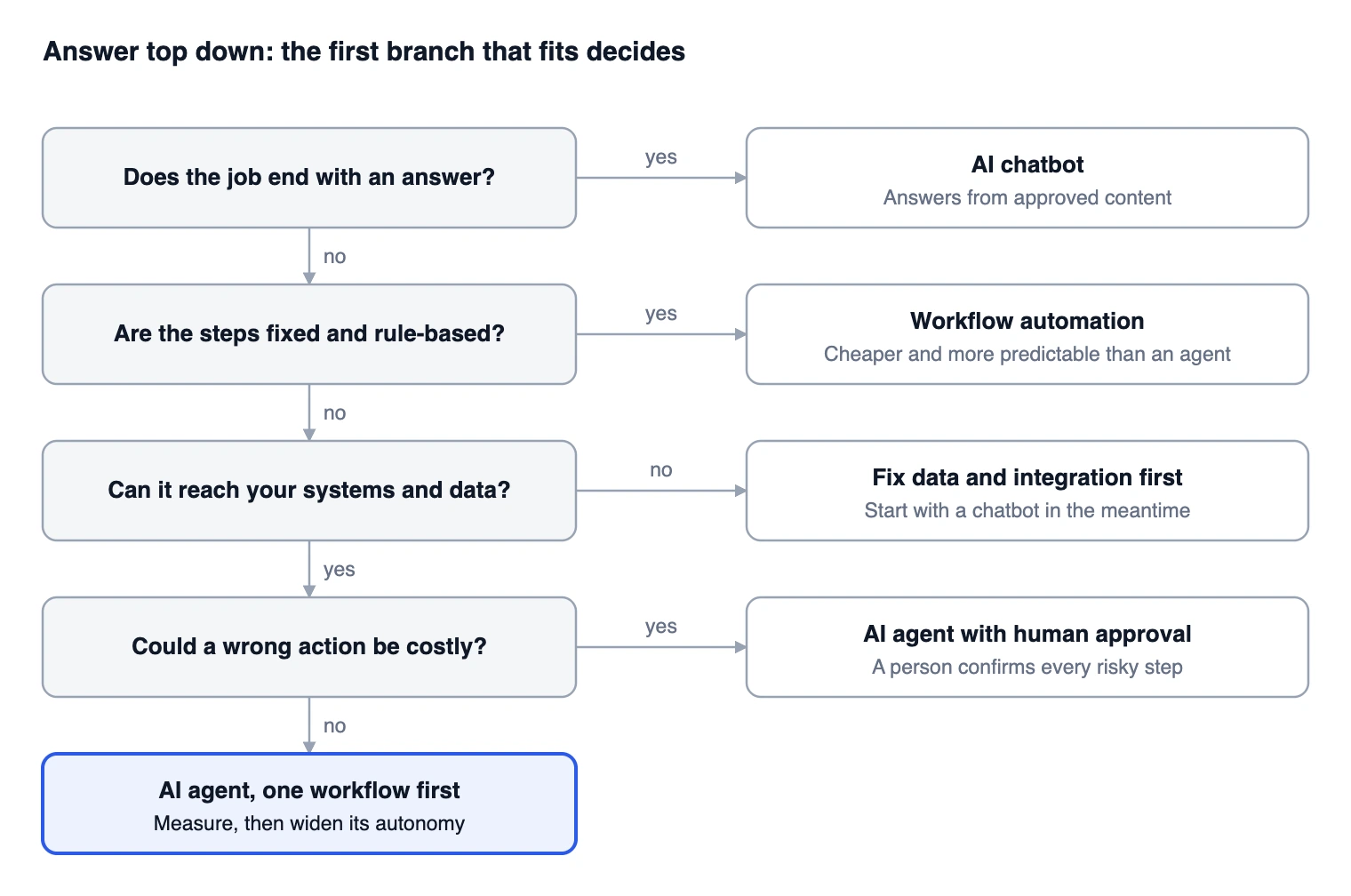
- Does the job end with an answer? If users need information, not an action, build a chatbot. It’s faster, cheaper and easier to keep accurate.
- Are the steps fixed and rule-based? If the process never varies, classic workflow automation does it more cheaply and more predictably than an agent. Agents earn their cost where cases vary and need judgement.
- Can it reach your systems and data? If the systems it must act in have no APIs and the data is incomplete, no agent will work reliably. Fix the data and integration first, and start with a chatbot meanwhile.
- Could a wrong action be costly? For payments, contracts, cancellations or regulated decisions, build an agent that prepares the action and a person who confirms it.
- Otherwise, pilot an agent on one workflow. Pick the one with the most volume and the clearest definition of done, measure it, then extend what it may do alone.
Check one more thing before you build: is the volume high enough to pay back the integration and running costs? If only a small share of requests ever reach the agent branch, a well-made chatbot with a fast hand-off to a person is often the better investment.
Already have a chatbot? How to upgrade it step by step
If your chatbot works, don’t replace it with an agent in one go. Add actions to it, one workflow at a time, and let the numbers decide the next step.
- Fix the answers first. Check which questions it fails, where users ask for a human, and which content is out of date. A chatbot that answers badly will act badly.
- Add read-only lookups. Order status, policy details, appointment times, pulled live from your systems with the user signed in.
- Prepare, don’t execute. The assistant fills in the return form or drafts the claim; the user or an employee confirms.
- Let it act on low-risk steps. Rebooking a slot or resending a document, with logs and an easy way back.
- Extend autonomy where the data proves it. Only for workflows with a high success rate in testing and in production.
There is a second upgrade to plan for. More customers now start in ChatGPT, Claude or Copilot rather than in your app or website. An MCP server lets those assistants use your products and services directly, the way a website lets Google find you. That is the same building block an agent uses, so the work serves both.
How we choose between a chatbot and an AI agent at Tapptic
We build both, so we don’t start with a preference. We start with five questions, worked through with your team:
- What does success look like for the user? An answer, or a finished task?
- Which systems are involved? Every API, data source and permission the job touches, checked before anything is built.
- What is the cost of a mistake? That decides where a human approves and how much the assistant can do alone.
- What volume and value are at stake? Enough to pay back integration and running costs, or better served by something simpler?
- Where do your users start? In your app, on your website, or increasingly inside ChatGPT, Claude or Copilot?
When the answers point to an agent, we prove it before you commit to a full build. Our AI App Discovery Sprint takes a few weeks at a fixed price. You get a working prototype on your real systems, a delivery roadmap and a committed price for the build